

The information industry encompasses businesses that create, organize, and sell knowledge. Instead of relying on physical products, these companies generate revenue through specialized digital goods, education, and services. A side hustle can apply the same model on a smaller scale by turning expertise, experience, or intellectual property into services or digital products alongside a primary source of income.
A key barrier-to-entry advantage of the information industry is zero inventory. In a knowledge business, this removes the need to purchase or store physical stock and creates a path from selling expertise directly to building repeatable products and systems.
You can package your expertise into consulting, business coaching, online courses, or paid virtual communities. This creates a knowledge-based side hustle that can begin with direct services and develop into more scalable offers as the method is documented and productized. The global e-learning market is projected to exceed $1 trillion by 2032.
This model eliminates the physical constraints of traditional retail. You can launch an offer without leasing warehouse space, managing stock, or coordinating shipping logistics.
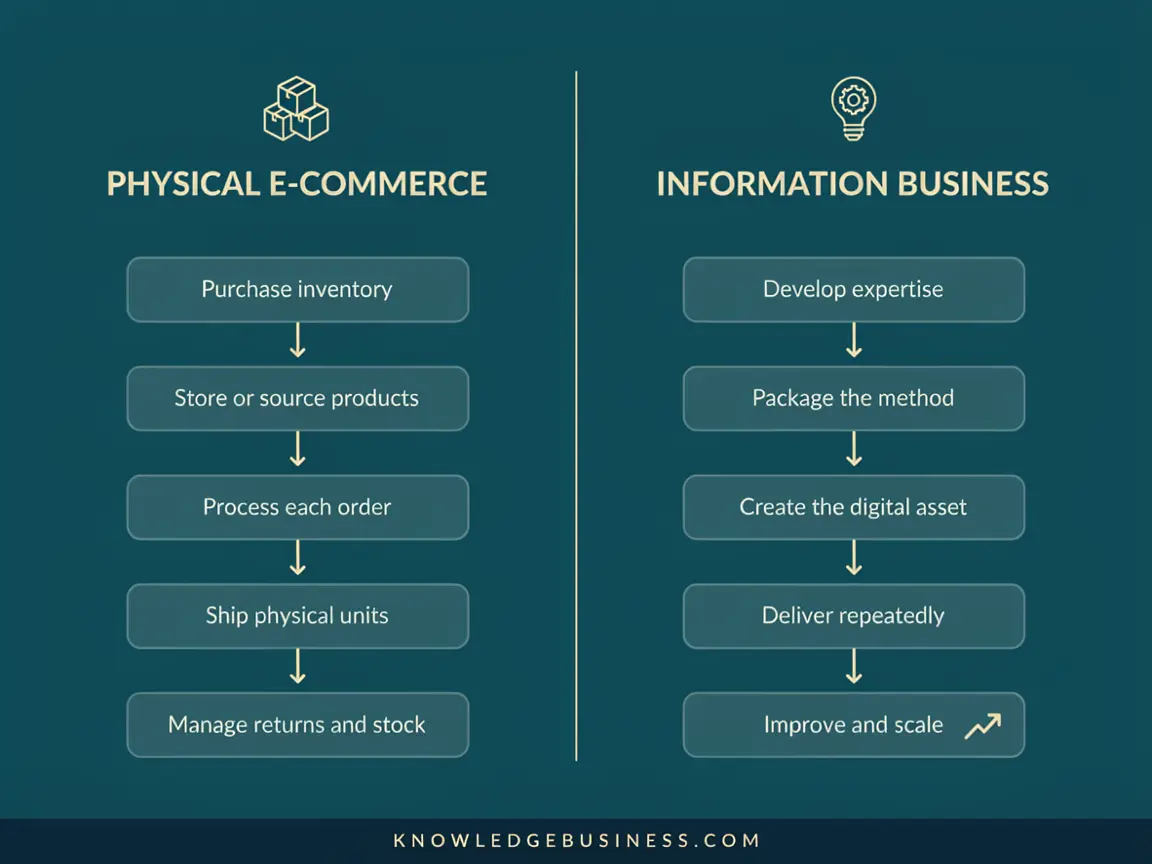
This creates a fundamentally different operating model from physical e-commerce. Amazon FBA sellers must purchase inventory upfront and manage marketplace fees. Dropshipping removes personal storage requirements, but every order still relies on supplier availability and physical fulfillment.
An information business avoids these physical limits entirely. A digital good, such as a framework, template, or online course, has a near-zero marginal cost of reproduction. You create the asset once, and it can be delivered repeatedly without depleting physical inventory.
While software, marketing, and community management require ongoing investment, these expenses do not scale linearly with each new customer. This decoupled cost structure makes high margins possible. However, high margins are an operational advantage, not a guaranteed financial result. Profitability requires a properly positioned offer that solves a real problem.
| Business model | Physical inventory | Cost of each additional sale | Primary constraint |
|---|---|---|---|
| Amazon FBA | Required | Product, storage, fulfillment, and marketplace costs | Capital and inventory management |
| Dropshipping | Supplier-managed | Supplier, shipping, and transaction costs | Supplier reliability and product margins |
| Consulting | None | Primarily the expert’s delivery time | Personal capacity |
| High-ticket coaching | None | Coaching time and client support | Access to the coach |
| Digital course | None | Minimal digital delivery costs | Customer acquisition and engagement |
| Paid community | None | Platform, moderation, and member support | Retention and participation |
Monetizable expertise helps a specific audience solve a critical problem, make a better decision, or achieve a desirable outcome. It is not limited to formal degrees or certifications.
Valuable expertise stems from professional experience, repeatable technical skills, or the ability to recognize patterns that others miss. The key is distinguishing between general knowledge and commercially useful frameworks.
For example, general "social media advice" is too broad to sell effectively. A stronger proposition is helping independent financial advisers create a compliant weekly LinkedIn content system. This tightly defined offer identifies the exact audience, operating environment, and intended result.
A strong area of expertise contains five core elements:
Before building an offer, audit your current knowledge base by asking yourself:
Your answers will reveal the most appropriate business model for your side hustle.
At this stage, the side hustle begins to form a knowledge business: personal know-how is being converted into reusable intellectual property that can be packaged, taught, licensed, or delivered repeatedly.
Packaging transforms raw expertise into a structured offer that customers can easily evaluate and purchase. Choose your format based on the nature of the customer's problem, not just popular trends.
Consulting
Consulting is ideal when a client requires complex diagnosis, expert judgment, or custom recommendations. The engagement should produce a concrete output, such as an audit or implementation roadmap, while providing direct access to customer problems and feedback. Delivery, however, remains limited by your available time.
Business Coaching
High-ticket coaching combines a structured methodology with direct access to the expert. Clients pay for accountability, personalized feedback, and implementation support. Pricing should reflect the depth of support, accountability, and personalized feedback provided.
Online Courses
An online course organizes expertise into a scalable, self-paced learning experience. Because you do not need to recreate the core material for every buyer, courses offer greater leverage than one-to-one delivery. The best courses focus on a defined outcome rather than overwhelming the student with unnecessary content volume.
Paid Communities
A paid online community provides continuous access, peer interaction, and ongoing support. Members stay for regular expert sessions, accountability systems, and networking opportunities. A static resource library is rarely enough to maintain recurring membership revenue.
Another way to build an information-industry side hustle is to work behind the scenes with a creator who already has an audience, helping turn that creator's expertise into a digital product. This creator-partnership side-hustle model shifts the focus from building your own audience first to developing and launching products for an existing one.
A common development path for knowledge entrepreneurs starts with consulting to gather direct customer insights. You can then use those insights to map out a coaching framework, eventually packaging that expertise into a self-paced online course or paid community to serve more customers without recreating the core expertise for each buyer or member.
A freelancer typically trades time for money by selling personal execution. An agency owner sells a managed service supported by defined processes, assigned responsibilities, and quality control.
For an information-industry side hustle, this is one way to scale expertise beyond the founder's personal delivery capacity. The transition requires moving from personal execution to team management by defining a clear scope, timeline, and deliverable for each service. Your delivery methods can then become standard operating procedures (SOPs) that trained contractors can follow.
Once the process is documented, you can separate high-level expert judgment from repeatable execution and assign production tasks to specialized contractors. This creates the operational foundation for building a scalable agency around a repeatable service model.
The information industry supports this transition without adding physical inventory or fulfillment requirements. Because the underlying expertise can be documented and taught, other people can help deliver the processes developed through the side hustle.
Stay in the know
Practical ideas to start, grow and scale your knowledge business, straight to your inbox.
No spam. Unsubscribe anytime.
Get found by the clients who need you
Join the home of trusted experts in the knowledge economy.
Only 100 founding member spots. After that, the price goes up.