
Russell Brunson's core strategy for scaling a side hustle is sales funnels: one customer journey built around a clear offer. For a knowledge business, that means resisting the urge to add more pages, products, tools, or marketing channels before one reliable customer journey is in place. That matters when you have limited time to sell manually.
This article explains how Brunson’s funnel-first approach helps business owners reduce manual selling and focus on one customer journey before adding more complexity.
Russell Brunson is the co-founder of ClickFunnels and author of the Secrets trilogy: DotCom Secrets, Expert Secrets, and Traffic Secrets. His business philosophy is commonly summarized as "You are only one funnel away."
The strategic idea is simple: an online business does not need a sprawling collection of pages, products, and marketing systems before it can grow. It needs one targeted pathway that connects the right audience with a clear offer and gives that audience an obvious next step.
That shifts the scaling question from "What else should I build?" to "How can I make this one customer journey work better?" The priority becomes improving a system before multiplying the number of systems you have to manage.
Russell Brunson's core strategy is sales funnels. A sales funnel is a marketing model that guides a prospect through a customer journey toward a purchase.
The strategic value of this approach is leverage. A course creator, coach, consultant, template seller, or membership owner may have only a few hours each day to market and sell. A funnel turns repeated sales explanations, including what the offer is, who it is for, why it matters, and what to do next, into a reusable customer journey.
This is why a funnel can function like a digital salesperson working 24/7 for a side hustler. The system can continue presenting the offer and guiding prospects when the owner is at a primary job, serving clients, creating the product, or offline. It does not guarantee sales, but it reduces the need to personally explain the same offer to every prospect.
That changes how limited time can be used. Instead of making every sale depend on a manual conversation, the owner can work on the offer, attract the right prospects, review feedback, and improve the journey that already exists.
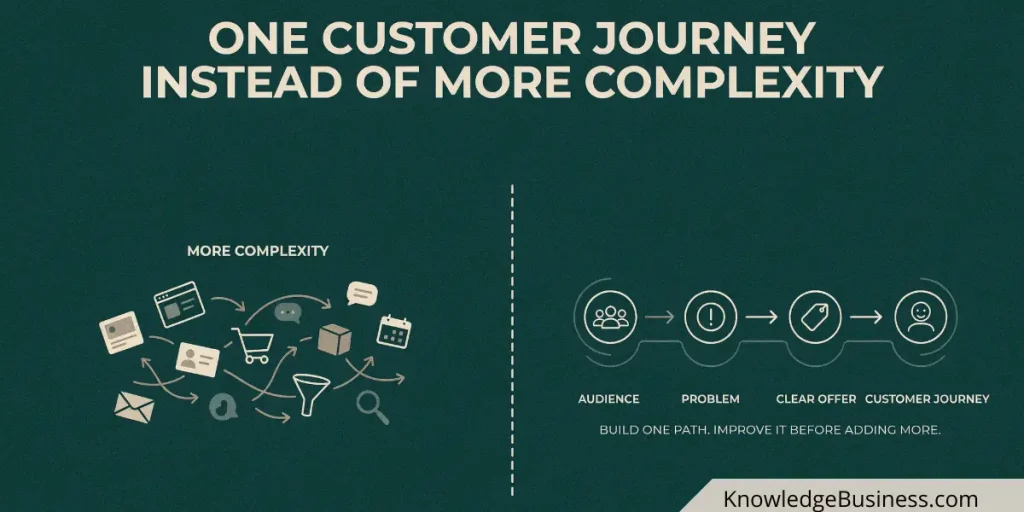
Traditional websites are not inherently bad. The problem is that they are usually built to support many intentions at once: learn about the brand, read articles, browse services, compare offers, or make contact. That flexibility can work against a side-hustle owner whose immediate goal is to move one type of prospect toward one offer.
Brunson's philosophy reverses the priority. Instead of asking, "What else should I add to my website?" the better question becomes, "What is the next decision I want the right prospect to make?" The answer shapes a more deliberate journey and removes choices that do not help that decision.
This matters when expertise is the product. An owner may otherwise spend valuable time repeating the same promise and process, answering the same objections, and explaining the same next steps in calls, direct messages, or email. A funnel packages that sales logic into a system that can be reused rather than rebuilt for every prospect.
Website-first vs. funnel-first scaling
| Website-first approach | Brunson's funnel-first approach |
|---|---|
| Build many pages and navigation choices | Build one path around one offer |
| Ask visitors to browse and decide what matters | Make the next action explicit |
| Repeat sales explanations manually | Build the core explanation into the journey |
| Add more tools or channels when growth stalls | Improve the existing path before adding complexity |
The One Funnel Away framework is most useful when treated as a constraint on complexity. You do not need ten products, dozens of web pages, five social platforms, and a complicated tech stack before you can grow. You need a small number of connected decisions that support one offer.
For a side hustle, this principle can be applied through four practical priorities:
For a solopreneur, this creates a practical order of operations. Build the smallest system that can explain and sell one offer, then use customer response to improve the message, offer, and journey before expanding into new products, channels, or software.
The philosophy is about concentration, not certainty. Its value is that one working path is easier to observe, improve, and manage than a collection of disconnected marketing activities competing for the same limited time.
One-Funnel Simplification Check
☐ Can you name one audience you are trying to reach?
☐ Can you describe the one problem your current offer solves?
☐ Is there one primary offer you want that audience to consider?
☐ Can you explain the route from first interest to the offer in a few steps?
☐ Could you remove a page, tool, or channel without weakening that route?
Brunson's scaling philosophy is closely connected with his work building ClickFunnels and teaching the ideas behind the Secrets trilogy. That broader context helps explain why sales funnels sit at the center of his approach to online business growth.
For a deeper look check out our full Russell Brunson bio to learn more at his companies, books, and career history. The strategic takeaway is simple: before adding more marketing, build one customer journey you can improve.
If you are looking for a structured implementation program built around the same side hustle principles, you can join Iman directly.