
Passive income is income that requires little to no ongoing effort to earn and maintain after the underlying asset and systems are operating. For a scalable side hustle, the primary mechanism of passive income is automation, which allows technology to perform repeatable processes with minimal human involvement.
In a knowledge business, expertise is packaged into digital products such as online courses, guides, templates, toolkits, or recorded workshops. Marketing automation then handles lead generation, email follow-up, payment processing, digital distribution, and customer onboarding.
The creator still performs substantial work upfront. Automation creates leverage, but it does not guarantee demand, revenue, or profit.
Passive income system at a glance
Reusable digital asset → Evergreen traffic → Landing page → Email sequence → Checkout → Automated delivery
Yes, but a side hustle does not become passive simply because it operates online.
A side hustle is work performed alongside a primary career and typically begins as a way to generate supplementary income.
To produce passive income, the side hustle must evolve beyond additional employment. Revenue must come from a reusable asset or automated system rather than depending on the owner completing work for every customer.
A consultant who sells one-on-one calls must personally attend every client session. That same consultant could transform a repeatable process into an online course that customers purchase and complete without scheduling a live appointment.
Research, production, testing, and promotion still require active work. Once the product and supporting systems operate reliably, each additional sale demands less direct involvement from the creator.
Automation uses technology to perform repeatable processes with minimal human assistance, making it the mechanism that allows a passive-income system to operate with less direct owner involvement.
Marketing automation applies this mechanism to activities such as attracting prospects, collecting contact information, sending email sequences, presenting offers, processing transactions, and delivering purchased products.
| Business Function | Manual Approach | Automated Approach |
|---|---|---|
| Lead Generation | Contacting individual prospects | Evergreen content and lead-capture pages |
| Follow-Up | Writing and sending individual messages | Scheduled email marketing and autoresponders |
| Conversion | Hosting sales calls or issuing invoices | Sales pages with integrated checkout |
| Fulfillment | Emailing files or granting access manually | Automated digital distribution |
| Customer Guidance | Repeatedly answering setup questions | Welcome sequences and structured member portals |
Lead generation builds interest among prospective customers and captures contact information so the business can continue communicating with them.
Once a prospect enters the system, email marketing delivers educational and promotional messages at planned intervals. The sequence may introduce the product, answer common questions, address objections, and direct the reader toward a purchasing decision.
Automation does not mean complete neglect. The owner must still monitor performance, resolve technical problems, answer complex support questions, maintain product quality, and update outdated material.
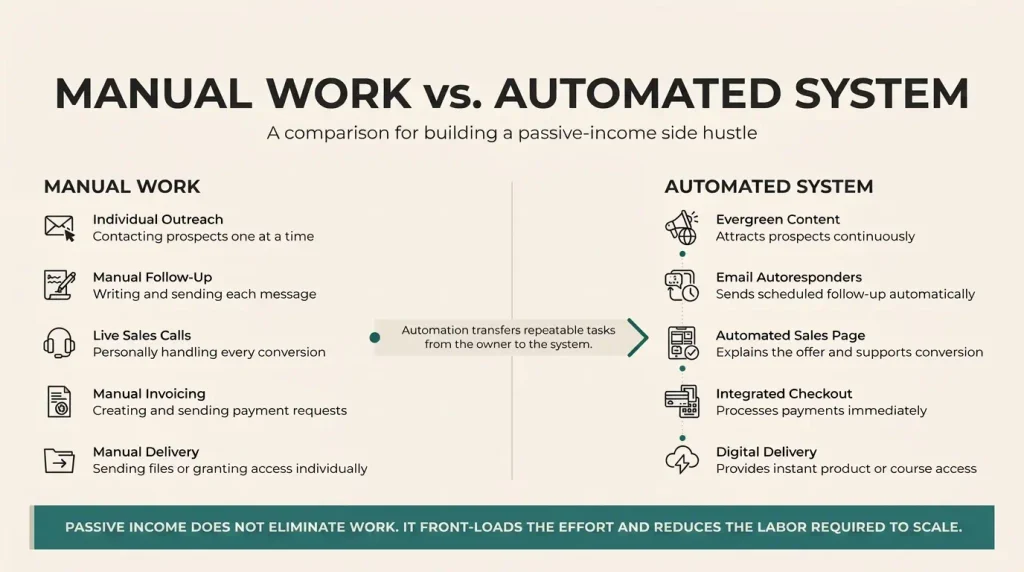
Passive income does not eliminate work. It changes when the work happens.
A traditional service business spreads labor across every customer engagement. An automated digital model concentrates most of the work before the asset begins generating revenue.
Before launching, creators must research market demand, build the product, write the sales message, prepare email sequences, configure payment systems, and test the delivery process. This requires substantial active effort before the system can operate with less ongoing involvement.
The difference becomes clearer as the system begins to scale.
| Stage | Primary Work |
|---|---|
| Research | Identifying a defined audience, problem, and product demand |
| Creation | Developing, recording, or writing the reusable asset |
| Setup | Building landing pages, email sequences, checkout, and delivery |
| Testing | Finding technical problems and reducing customer friction |
| Maintenance | Monitoring performance and updating the product |
| Scale | Sending more qualified prospects through the existing system |
Once the system operates reliably, the same digital product can be sold and delivered to additional customers without being rebuilt for every purchase.
The Asymmetric Effort Rule: Concentrated upfront labor creates a reusable digital asset that can generate repeated sales with limited ongoing involvement.
This structure does not guarantee income. It creates an entrepreneurial model in which earning potential is less dependent on the owner personally delivering every service in real time.
Generating sales while offline requires more than publishing a product page. Every stage of the customer journey must connect smoothly to the next.
The process typically begins with content marketing. This form of digital marketing uses articles, videos, audio, and other useful material to attract and educate a defined audience.
Content marketing supports lead generation by directing potential customers to a landing page. A landing page is a focused web page designed to capture a visitor's contact information or direct them toward a specific offer.
This may offer a guide, checklist, template, or short training in exchange for the visitor's contact information. Once the prospect opts in, an automated email sequence provides education, builds trust, and introduces the paid offer.
A low-maintenance digital business needs five connected layers:
Missing one layer creates friction and increases manual intervention. A strong product without traffic remains invisible, while lead generation without follow-up may produce inquiries that never become customers.
A completed sale without automated digital delivery also forces the owner to fulfill each order manually.
Passive Income Automation Audit
Use this checklist to identify gaps in the system:
The more questions answered “yes,” the less the business depends on continuous owner involvement.
A sales funnel represents the customer journey from initial interest toward purchasing a product or service.
An evergreen sales funnel connects content marketing, lead generation, landing pages, email follow-up, checkout, onboarding, and digital fulfillment. Each stage guides the prospect toward the next appropriate action.
A simple automated funnel follows this path:
Helpful content → Landing page → Lead magnet → Email sequence → Sales page → Checkout → Digital delivery
Someone may discover a useful article through a search engine. The article directs the reader to a landing page offering a practical checklist in exchange for an email address.
The prospect then enters an automated sequence that explains the problem, introduces the product, answers common questions, and directs the reader to a sales page. When the customer purchases, the system processes payment and provides immediate access through automated digital distribution.
Software handles the repeatable steps with minimal human involvement. The creator can then focus on improving the product, supporting customers, publishing useful content, and expanding audience reach.
Creators can study Russell Brunson's sales funnel frameworks to understand how automated conversion pathways move prospects from initial interest to a purchasing decision. For a deeper look at how these systems work, explore the Russell Brunson funnels pillar on this site.
Stay in the know
Practical ideas to start, grow and scale your knowledge business, straight to your inbox.
No spam. Unsubscribe anytime.
Get found by the clients who need you
Join the home of trusted experts in the knowledge economy.
Only 100 founding member spots. After that, the price goes up.