

When you have a full-time job and a side hustle, time management is essential for making consistent progress without letting the extra work take over your week. In this situation, time management has a practical weekly constraint of 10 hours. Most professionals can realistically dedicate 10 to 15 hours per week to additional work without creating an unsustainable schedule.
At KnowledgeBusiness.com, we have found that those limited hours are most effective when they are concentrated on product creation and lead acquisition. The strategies below are designed to help coaches, consultants, course creators, and other knowledge-business owners use that time more deliberately while maintaining clear boundaries around work and personal responsibilities.
Manage your side hustle as a fixed 10-hour weekly system rather than treating it as a second full-time job. This limit creates clear boundaries around your primary job, health, relationships, and family responsibilities.
Planning around a strict 10-hour baseline creates clear operating boundaries and forces you to decide which activities deserve your limited attention.
One illustrative 10-hour allocation could be:
Every other activity should support one of these three priorities.
Within that 10-hour weekly limit, time management becomes a prioritization system: each work session must be assigned to tasks that produce measurable business progress.
Parkinson’s Law states that work expands to fill the time allotted to it. Without clear boundaries, one vague task can consume an entire work session without producing a measurable result.
Every scheduled work session should include four elements:
For example, “work on the course” is too broad. A clearer task would be:
Complete the outline for module one between 7:00 and 8:30 p.m.
This creates a specific deliverable, a firm time boundary, and a clear definition of completion.
Time blocking assigns a specific activity to a protected period on your calendar. It turns a general intention into a scheduled commitment.
Use longer, uninterrupted blocks for work requiring deep concentration. These tasks may include:
Schedule demanding work during the hours when your energy and concentration are highest. Reserve lower-energy periods for simpler administrative actions, such as scheduling content, organizing files, responding to routine messages, or reviewing analytics.
Reduce distractions during focused work
During a protected time block, close all unrelated browser tabs, silence your phone, and remove unnecessary notifications.
Combining time management with attention management helps you direct your concentration toward one exact deliverable. The goal is not to remain busy throughout the entire block. The goal is to complete the predetermined output.
Time blocks should also include stopping points. Continuing beyond the scheduled period may reduce the time available for rest, family responsibilities, or your primary job. These stopping points also protect recovery time and help reduce the risk of occupational burnout.
The Pareto Principle, commonly called the 80/20 rule, proposes that roughly 80% of results often come from 20% of activities. For a time-limited side hustler, this principle provides a framework for identifying and protecting high-leverage work.
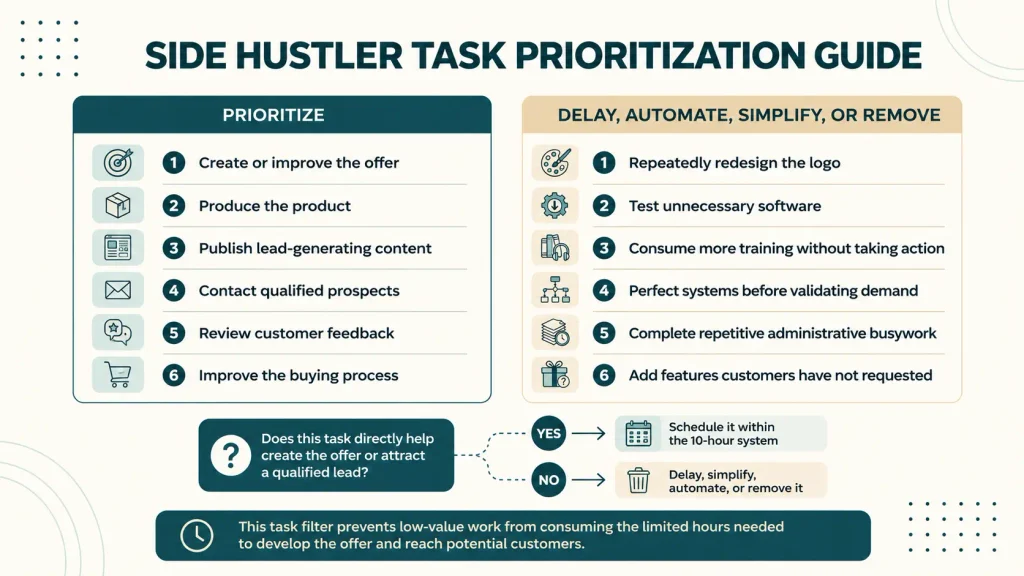
The two highest-leverage activity categories are:
Low-value activities consume limited weekly hours without moving the business closer to a customer or sale. These activities may include:
A firm deadline converts limited weekly effort into a focused preparation period. The immediate objective is to establish a functional business foundation before the 2026 Side Hustle Summit.
Before the event, aim to establish four baseline assets:
The purpose is not to arrive with a flawless or fully scaled business. It is to arrive with enough structure to understand, evaluate, and implement more advanced scaling strategies.
A fixed 10-hour weekly system can help you build a sustainable side hustle without A fixed 10-hour weekly system gives you a practical foundation for making consistent progress on the activities that matter most. With a clear offer, a repeatable lead-acquisition method, and a sustainable schedule in place, you can begin thinking about how to grow from there. If you want to explore that next stage, you can join the 2026 Side Hustle Summit to learn more about building and scaling your side hustle.
Stay in the know
Practical ideas to start, grow and scale your knowledge business, straight to your inbox.
No spam. Unsubscribe anytime.
Get found by the clients who need you
Join the home of trusted experts in the knowledge economy.
Only 100 founding member spots. After that, the price goes up.