

A side hustle needs a sales funnel to scale because growth requires a system that converts attention into customers without depending on a live conversation for every sale. The funnel's core function is automated conversion: a planned sequence that guides a prospect from first awareness to a purchasing decision.
For a knowledge business built around coaching, consulting, digital products, or other expertise-based offers, this creates a repeatable sales process. The same funnel can present the offer, answer common questions, and direct interested prospects toward the next step.
A sales funnel organizes the customer journey into stages rather than treating first contact and purchase as one interaction. Each stage has a clear job and moves the prospect closer to a buying decision.
For a side hustle, a simple funnel might begin with content or an advertisement, continue to a landing page or lead magnet, present the offer on a sales page, and end at checkout.
Automated conversion is the core function of a sales funnel. The steps are built in advance through content, landing pages, sales pages, and checkout steps so interested prospects can move forward without requiring the owner to explain each step personally.
For a side hustler with limited time, this creates leverage. The funnel can continue guiding prospects while the owner creates the product, serves customers, or attracts more people to the business. This same principle also underpins Russell Brunson's sales funnel strategy, which focuses on building a structured path from attention to purchase.
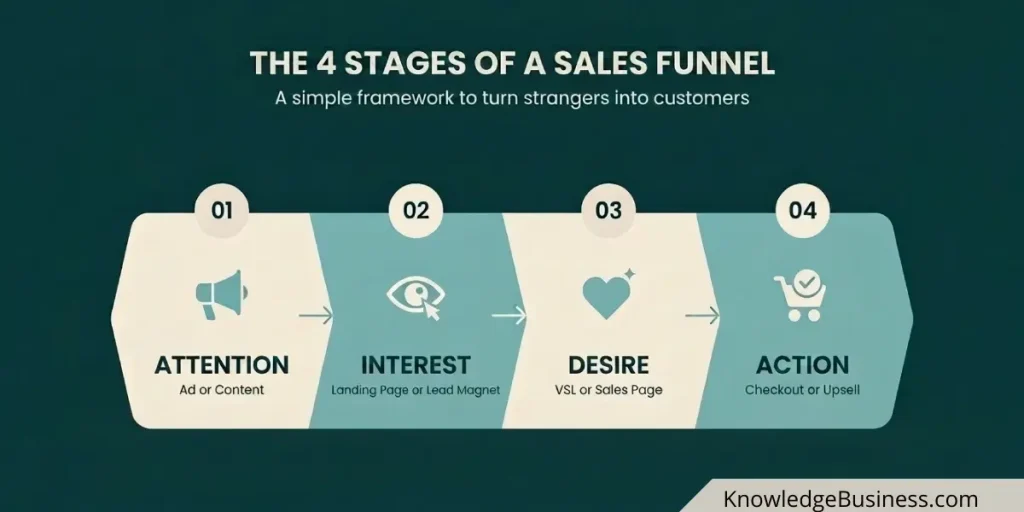
A sales funnel can be organized around the AIDA marketing model: Attention, Interest, Desire, and Action.
| Stage | Funnel Element | Purpose |
|---|---|---|
| Attention | Ad or content | Makes the prospect aware of the offer |
| Interest | Landing page or lead magnet | Gives the prospect a reason to learn more |
| Desire | VSL or sales page | Shows why the offer is relevant to the prospect |
| Action | Checkout or upsell | Gives the prospect a direct path to purchase |
Each stage has one clear role. Together, the stages create a continuous pathway from initial awareness to a purchasing decision.
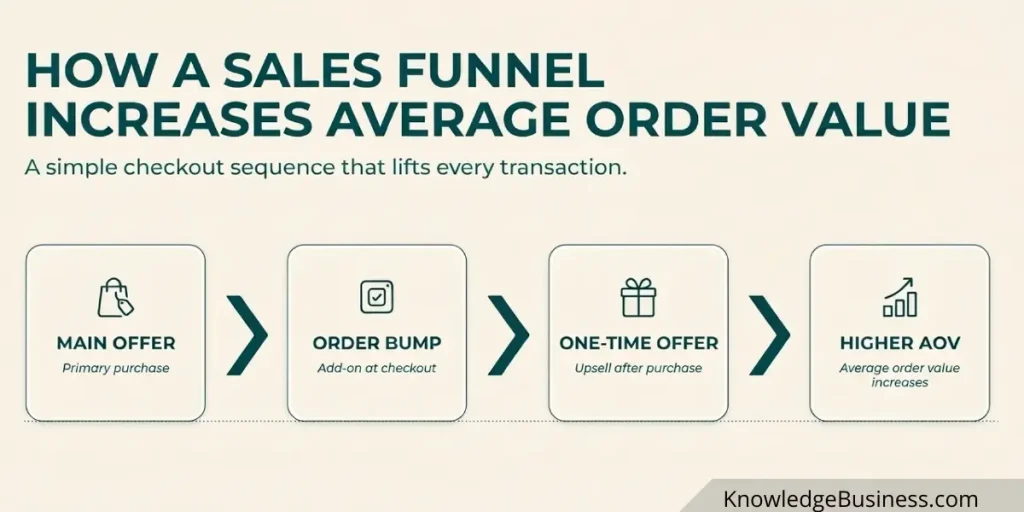
A funnel can also increase Average Order Value (AOV), the average amount generated per order, by presenting relevant additional offers during the buying process.
An order bump adds a related offer during checkout. A One-Time Offer (OTO) gives the buyer an additional offer within the purchase sequence.
For example, someone buying an online course might add a related workbook at checkout or see a complementary offer immediately after the purchase.
The goal is to increase the value of a transaction without adding unrelated products. Each additional offer should make sense based on what the customer is already buying.
See how an order bump and One-Time Offer could affect your average order value.
A funnel becomes more useful when its offers follow a logical progression. A value ladder organizes products and services so a customer can move from an entry offer toward higher-value options as the relationship develops.
The distinction is simple: the sales funnel manages the conversion pathway; the value ladder organizes the offer progression.
Together, they give a side hustle a clearer path from first attention to an initial purchase and future offers.