
Eben Pagan's approach to AI marketing is to direct AI with personal expertise, customer context, and an authentic voice. Eben Pagan teaches business owners to give AI the information and direction it needs, rather than expecting a general prompt to produce marketing that reflects their expertise.
For a knowledge business, this is especially useful. Coaches, consultants, and course creators need marketing that communicates what they know and addresses the problems their customers actually face. AI can help create a first draft, but the quality of the message still depends on the facts, experience, and judgment behind it. Pagan explores this idea through frameworks and practical systems highlighted in his AI books.
Download The A.I. Marketing Script Book for Free
Eben Pagan has spent 25 years building and teaching online businesses. He has co-founded two A.I. startups (one was acquired) and has taught A.I. inside Tony Robbins' Business Mastery. His background also includes creating online education and coaching programs such as Future Coach, which brings AI tools into a broader coaching curriculum.
His approach to AI marketing connects two areas of experience: understanding how people decide to buy and understanding how to direct AI tools. The focus is not on replacing the knowledge of a business owner, but on using that knowledge to guide marketing research, writing, and revision.
AI can write fluent text even when it knows almost nothing about your business. Ask it to “write an email promoting my coaching service,” and you may get a polished message about transformation, success, and taking the next step. The words sound familiar because they could describe almost any coaching offer.
What's missing is what makes your service useful to a particular person. AI doesn't automatically know your customers' questions, the boundaries of your offer, or the way you explain your work. Without that context, it may rely on broad claims or add details that you never supplied.
This is where prompt engineering becomes useful. It means creating and refining instructions for an AI model. In copywriting, those instructions can include the customer, the specific task, reliable information about the offer, your preferred voice, and clear limits on what the AI may claim.
Good marketing helps someone recognize their problem and understand a relevant solution. Before asking AI to write, identify who you're speaking to, what they need, what you actually offer, and how you would explain it in a conversation.
Imagine a coach who runs a workshop for independent consultants struggling to organize their new-client onboarding. Compare a vague instruction with one that includes the information a real copywriter would need:
Write a short, friendly email for independent consultants whose onboarding notes and follow-ups are scattered across different tools. Explain my 45-minute workshop on building a repeatable client onboarding checklist. Keep the language practical and encouraging. Don't invent testimonials, results, or features I haven't mentioned.
That prompt gives AI a more useful starting point because it specifies a customer problem, an offer, and a voice. The owner still needs to check the draft: Does it describe the workshop accurately? Does it sound natural? Would it help the intended reader make an informed decision?
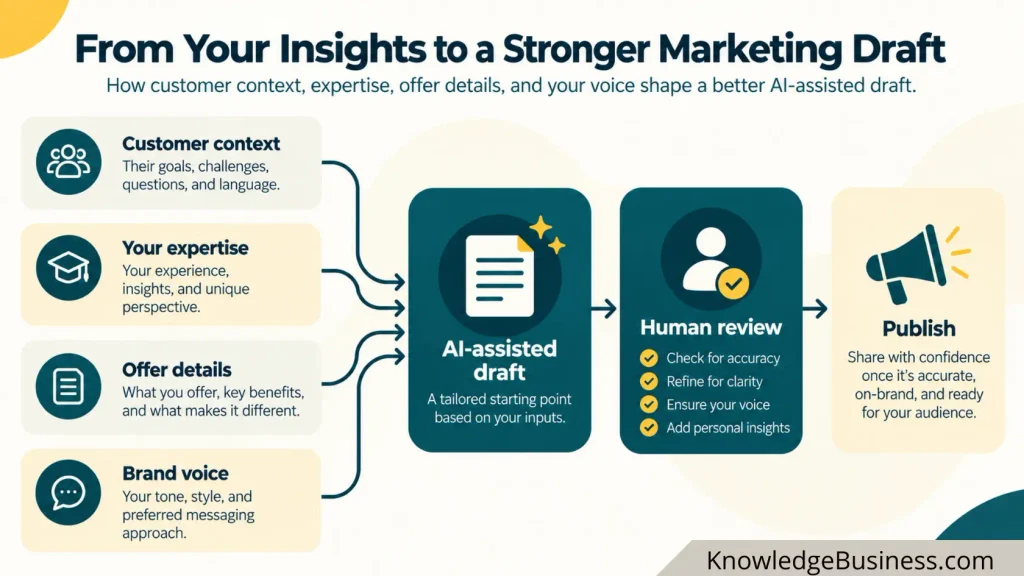
In The A.I. Marketing Script, Eben Pagan covers four AI marketing approaches: You, I, Do, Why for prompting, Knowledge Squared for applying expertise, an intelligence bank for organizing business information, and Warmer, Colder for refining AI-generated content through feedback.
In A.I. Opportunities, drawing on 67 expert interviews, Pagan also discusses Joe Stolte's GRIT prompting method (Goal and Role, Return Format, Instructions, Tailored Context), asking AI to identify missing information, and eliminate → optimize → automate for improving business processes.
You, I, Do, Why is a prompting script Pagan covers for creating marketing with AI. Knowledge Squared is his model for explaining how AI can amplify someone's existing knowledge and expertise.
Someone who understands their customers, offers, and industry can provide more useful instructions than someone relying on a general prompt.
For example, imagine two course creators asking AI to write a landing-page introduction. One provides only the course title. The other includes the course description, common student questions, and examples of their own writing.
Both use the same AI tool, but the second provides more relevant context. This can help AI produce content that better reflects the course, its audience, and the creator's voice.
An intelligence bank is a collection of reusable documents that give AI context about your business, customers, offers, and messaging. It helps you avoid repeating the same information every time you create marketing content.
Pagan highlights Google Docs as a practical place to store these materials instead of relying entirely on an AI tool's memory. You can review, update, and reuse the documents across different AI tools.
Your intelligence bank might include:
This approach supports knowledge management by keeping business information organized and consistent.
When creating marketing content with AI, provide the documents relevant to the task. Check that the information is current, and avoid sharing private customer details without permission.
Try the prompt builder below to combine your audience, their problem, your offer, and your brand voice into a reusable AI instruction.
Give AI your audience, their problem, your offer, and your natural voice. The tool creates a starting prompt, not finished or verified marketing copy.
Pagan describes Warmer, Colder as a feedback approach for improving AI-generated marketing. Instead of asking AI to "make it better," explain what works and what needs changing.
For example, after reviewing an email draft, you might say: "Keep the explanation of the customer's problem. Remove the unsupported promise of instant results. Make the next version more specific about what the workshop covers."
Specific feedback helps AI produce a more relevant draft. Review each revision to ensure the content accurately represents your offer, reflects your voice, and addresses your customers' needs.
Not every marketing task needs automation. Before introducing AI into a process, consider whether the task is necessary, whether it works effectively, and whether automating it would actually improve the customer experience.
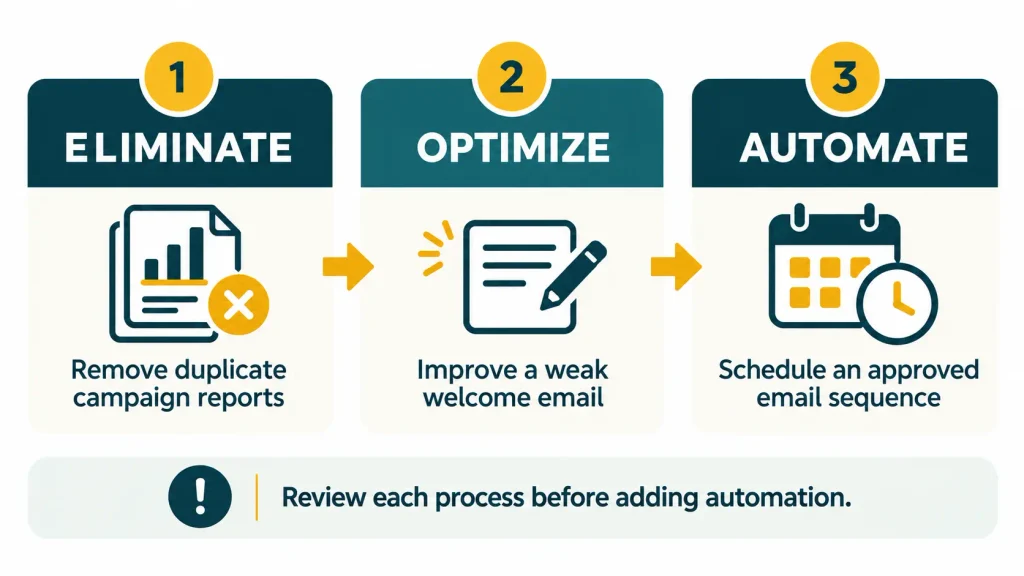
A useful approach is eliminate → optimize → automate, a sequence explored in Eben Pagan's A.I. Opportunities.
Start by removing tasks that no longer serve a purpose. Improve the processes that still matter, then look for opportunities to automate repetitive work.
For example, a business might eliminate a duplicate campaign report, improve a confusing welcome email, and automate delivery of an approved email sequence. Each step addresses a different problem instead of simply making existing work faster.
Customer communication requires more careful consideration.
At Ontraport, a marketing and sales automation software company, AI helps research potential customers and prepare outreach emails. Sales representatives review the drafts and decide whether to send or edit them. This allows the business to benefit from AI assistance while keeping people responsible for customer communication.
The same principle applies to customer complaints, disputed facts, or messages that require individual judgment. AI can help prepare a response, but a person should verify that the information is accurate, appropriate, and consistent with the business's promises. Private customer information should also be handled carefully and shared only through approved tools.
The goal is to automate work where it adds value while keeping human judgment where it matters most.
AI-generated marketing can sound convincing while containing incorrect information. The National Institute of Standards and Technology (NIST) identifies this risk as confabulation in its Generative AI Profile, alongside privacy and information integrity concerns.
An AI-generated landing page might invent a product feature, while a sales email could include an unsupported statistic, fabricated testimonial, or unrealistic promise. These mistakes can mislead customers and damage trust.
Before publishing, verify product details, dates, statistics, and claims against reliable sources. Remove unsupported guarantees, protect private customer information, and review the content for accuracy and brand voice.
AI can help create marketing content, but you remain responsible for what you publish.
The A.I. Marketing Script is a free book for anyone who wants to improve AI-generated emails, landing pages, and other marketing content using their own expertise, customer knowledge, and natural voice.
Join to Get The A.I. Marketing Script
A.I. Opportunities is a free book that explores how entrepreneurs can use AI across different areas of their business, including decision-making, prompting, and automation.
Join to Get A.I. Opportunities
For live examples, the free A.I. Marketing Expo takes place November 6–8, 2026, featuring presentations and demonstrations from AI marketing experts.
Join the Free A.I. Marketing Expo
A.I. Marketing Academy is a separate paid training program. Free Expo registration does not include access to the Academy.